


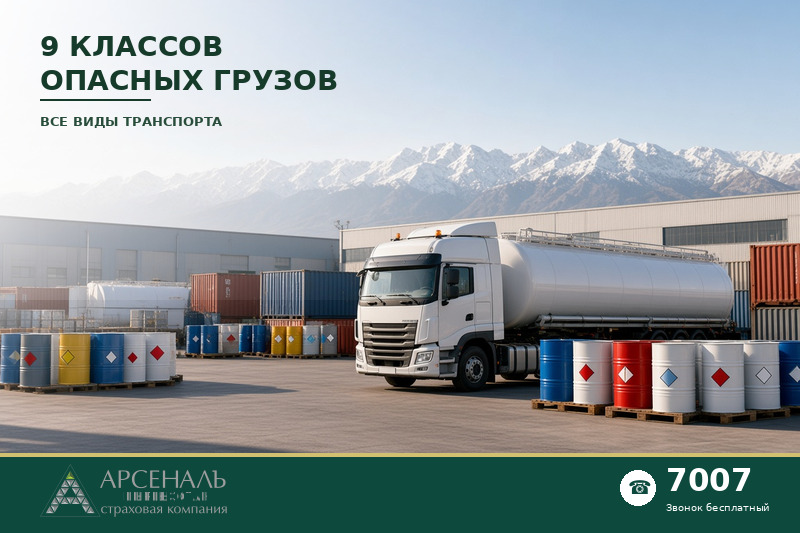
Classes of Dangerous Goods under OSGO OG
The class of dangerous goods is important when organising their transportation and determining the parameters of compulsory insurance.
The Law of the Kyrgyz Republic divides dangerous goods into nine classes.
Class 1 — Explosives
This class includes explosives and articles containing explosives in cases provided for by legislation.
Class 2 — Gases
This includes:
- compressed gases;
- liquefied gases;
- gases dissolved under pressure.
Class 3 — Flammable liquids
The class includes flammable liquids and corresponding mixtures, solutions, and suspensions.
Class 4 — Flammable substances and materials
This class includes flammable solid substances, self-igniting substances, and substances that release flammable gases when interacting with water.
Class 5 — Oxidising substances and organic peroxides
Includes oxidising substances and organic peroxides.
Class 6 — Toxic substances
The class includes toxic substances capable of causing poisoning when inhaled, ingested, or in contact with the skin.
Class 7 — Radioactive and infectious substances
The class includes radioactive substances and infectious substances containing pathogenic microorganisms dangerous to humans or animals.
Class 8 — Caustic and corrosive substances
These are substances capable, upon direct contact, of causing serious damage to living tissue, as well as damaging other cargo or vehicles.
Class 9 — Other dangerous substances
The class includes substances that, by their properties, do not belong to the previous classes but require special safety measures during transportation.
Why the class is important for OSGO OG
The sum insured under the contract depends, in particular, on the class of dangerous goods and the carrying capacity of the cargo vehicle.
How many classes of dangerous goods are there?
The law identifies nine classes.
Which class do petrol and other flammable liquids belong to?
The corresponding flammable liquids belong to Class 3 if the prescribed classification criteria are present.
Which class do gases belong to?
Compressed, liquefied, and gases dissolved under pressure belong to Class 2.
Does the class of cargo affect the cost of OSGO OG?
The class of dangerous goods is taken into account when determining the sum insured and the insurance premium.
The specialists of the Closed Joint-Stock Insurance Company "ARSENAL-KYRGYZSTAN" are ready to advise you on any questions
📞 7007 — toll-free call